










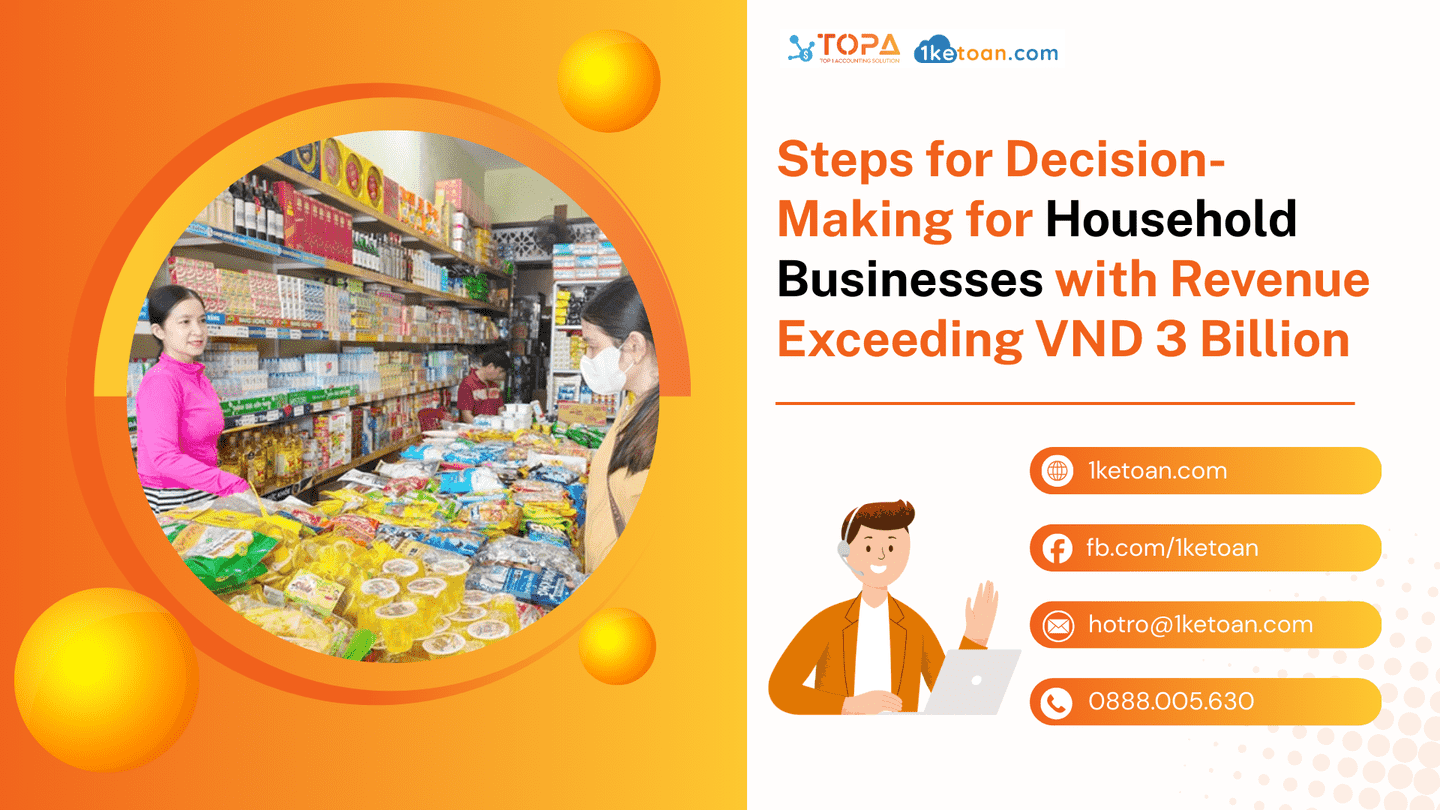

Businesses with revenue from 3–50 billion VND: Which model should you choose?
Nội dung
1.1. Most importantly: Prepare valid input expenses
For household businesses, valid input documentation acts as a “shield” that reduces tax risks and helps optimize the tax payable. Valid input documents include:
(A) Valid invoices and documents
- VAT invoices (with tax authority codes) issued by enterprises.
- Sales invoices issued by household businesses (with tax authority codes).
- For imported goods: complete import dossier as required by law.
(B) Expenses accepted even without invoices
Certain types of specific expenses do not require invoices but are still accepted if proper supporting documents are provided:
1) Purchasing goods and services in the following cases:
- Agricultural, forestry, and fishery products sold directly by producers or fishers.
- Handcrafted items (jute, rush, bamboo, rattan, coconut fiber, etc.) sold directly by artisans.
- Soil, stones, sand, gravel exploited and sold by individuals/households.
- Scrap collected and sold directly by individuals.
- Assets or services sold directly by non-business individuals.
- Goods or services purchased from individuals/household businesses earning under VND 100 million/year and not subject to VAT.
🔎 Mandatory note:
You must prepare a purchase statement with corresponding payment documents.
2) Statement form 01/TNDN
Must be prepared for each purchase using Form 01/TNDN under Circular 78/2014/TT-BTC.
3) Required accompanying documents:
- Sales contract or purchase agreement.
- Payment documents: cash voucher or bank debit advice.
- Delivery record or warehouse receipt.
❓ What if there are no input documents?
Tax implications
- Revenue > VND 3 billion/year: Tax is calculated on taxable income.
→ No input costs → higher profit → tax payable increases significantly. - Revenue ≤ VND 3 billion/year: Tax is calculated as a percentage of revenue.
→ Less impacted, but still subject to market and source-of-origin inspections.
Other risks
Origin verification:
If input records are missing or suspicious, the Tax Authority may:
- Request explanations,
- Forward information to market surveillance, economic police, or inter-agency forces.
On-site inspections:
Market surveillance teams may directly inspect to:
- Verify invoices and documents,
- Seize goods,
- Impose administrative penalties,
- Consider further legal liability.
This is especially risky for regulated industries:
- Food & beverages
- Pharmaceuticals and medical services
- Cosmetics, branded goods, imports
- Branded fashion, imported electronics
A small mistake can lead to major legal consequences.
1.2. Understand your applicable tax calculation method
Currently, household businesses fall under two main tax regimes:
(1) Tax calculated as a percentage of revenue
- Applied for revenue from VND 200 million to under VND 3 billion/year.
- Simple calculation.
- Limited fluctuations.
- No need to justify input expenses.
(2) Tax calculated based on taxable income (profit)
- Applied for revenue from VND 3 billion/year and above.
- Requires clear proof of revenue – expenses – profit.
- Higher profit → higher taxes.
- No input expenses → inflated profit → significantly higher taxes.
Most dangerous risk: Taxes + administrative penalties may exceed the business’s real profit.
1.3. Plan and adjust your business operations
To operate stably and minimize risks, household businesses should prepare:
(A) Input cost planning
- Choose reputable suppliers.
- Request valid invoices.
- Fully archive documents.
(B) Operational and legal cost planning
- E-invoice fees.
- Accounting service fees or in-house accounting staff.
- License tax, VAT, PIT on a monthly/quarterly basis.
(C) After-tax profit planning
- Calculate net profit after tax in advance.
- Define appropriate revenue targets.
- Track cost of goods sold and operating costs monthly.
The clearer the plan → the safer the business → the lower the risk of inspection or penalties.
Conclusion: Where should household businesses begin for safety and optimization?
In practice, most risks do not arise from intentional violations but from a lack of understanding — especially during 2025–2026, when tax policies are tightening and shifting significantly.
By preparing complete input documentation, understanding tax calculation methods, and planning financial and legal matters early, household businesses can avoid:
- Unnecessary tax increases
- Inspection risks, penalties, or goods confiscation
- Cross-agency legal risks (market surveillance, economic police, customs…)
- Cash-flow disruptions due to unexpected tax liabilities
✔ But you don’t have to navigate regulations, forms, and risk checks alone.
1ketoan — with years of experience supporting household businesses in Ho Chi Minh City and other provinces — can help you:
- Review input documents, expenses, and contracts to reduce tax risks
- Accurately calculate taxes based on your revenue bracket
- Design proper documentation procedures tailored to your business model
- Plan post-tax costs and profits clearly
- Advise sale–purchase processes to avoid mistakes from the start
- And most importantly: help you operate smoothly, without fear of inspections or missing documents
In a landscape of constantly changing tax policies, having an accounting team by your side ensures not only accurate declarations but long-term operational safety.
If you need a quick assessment of your input documentation, tax calculation, or a customized compliance roadmap, the chief accountants at 1ketoan are ready to support you transparently and wholeheartedly.
Business can be complicated — but your tax obligations don’t have to be, when you have a reliable guide.
Draft Accounting Circular 2026 – Key Updates Sole Proprietorships Must Pay Attention To
Businesses with revenue from 3–50 billion VND: Which model should you choose?