









Comparison between converting to an Enterprise and remaining a Household Business with revenue exceeding VND 3 billion
Please refer to the comparison table below or download the comparison table here: Link
| Criteria | Group 3 – Revenue > VND 3 billion | Enterprise (Revenue from VND 3–50 billion) | Assessment |
| Value-Added Tax (VAT) | – Mandatory application of the credit methodVAT payable = Output VAT – Deductible input VAT | – Mandatory application of the credit methodVAT payable = Output VAT – Deductible input VAT | Same |
| Personal Income Tax (PIT) | Calculated based on taxable income × 17%(Taxable income = Revenue – deductible expenses) | The enterprise only withholds and pays Personal Income Tax on behalf of its employees. | |
| Corporate Income Tax (CIT) | Not applicable | Calculated based on taxable income × 17%(Taxable income = Revenue – deductible expenses)Important: Eligible for tax incentives for 2–3 years under the business conversion incentive policies | Calculated in a similar manner to Personal Income Tax for household businesses, but with tax incentives applied. |
| Revenue Declaration Responsibility | Monthly filing (if annual revenue exceeds VND 50 billion) or quarterly filing, with annual finalization | Monthly filing (if annual revenue exceeds VND 50 billion) or quarterly filing, with annual finalization | Same |
| Invoices | Mandatory use of e-invoices with tax authority codes or e-invoices generated from cash registers | Mandatory use of e-invoices with tax authority codes or e-invoices generated from cash registers | Same |
| Accounting Books | Mandatory compliance with the accounting regime applicable to micro-enterprises or small and medium-sized enterprises | Mandatory compliance with the accounting regime applicable to micro-enterprises or small and medium-sized enterprises | Same |
| Legal Status | No legal personality; the household owner bears unlimited liability | Has legal personality; liability is limited to the contributed capital | Household businesses bear higher liability |
| Legal Risks | High, as the household owner is liable with all personal assets | Lower (limited liability) | Household businesses bear higher risk |
| Operating Costs | Lower than enterprises, but expected to increase significantly from 2026 due to full requirements for tax declaration, accounting, and invoicing | Higher: accounting costs, mandatory social insurance (when employees are hired), and compliance with more administrative procedures | Costs are expected to become comparable over time |
| Loans | Difficult to access, with low credit limits, secured by personal assets | Easier access to loans, higher credit limits, secured by enterprise assets | |
| Penalties | Half of the penalties applicable to enterprises | Penalties as prescribed by regulations | Household businesses are subject to lighter penalties than enterprises |
Accordingly, household businesses (HKDs) with revenue exceeding VND 3 billion, classified as Group 3, are subject to tax and accounting requirements that are the same as or similar to those applicable to enterprises.
Question 1: What is the correct method for calculating Value-Added Tax (VAT)? What is the proper understanding?
Currently, most goods and services are subject to VAT at a rate of 8%. In addition, there are still certain categories of goods and services subject to 5%, 10%, or exempt from VAT; however, these account for a relatively small proportion.
VAT only arises for goods and services that are supported by valid VAT invoices, or for imported goods on which VAT has been paid at the importation stage. Therefore, purchases without invoices, or purchases from household businesses that only issue sales invoices, are not eligible for VAT deduction.
For household businesses, special attention should be paid to the following point:
The selling price to the final consumer is a VAT-inclusive price. In practice, most household businesses sell directly to individual consumers, so the understanding and separation of the VAT component within the selling price is often overlooked.
Example on a VAT invoice:
A consumer pays VND 8,490,000 for a Xiaomi TV.
This amount includes:
- Net value of goods (excluding VAT): VND 7,861,111
- VAT at 8%: VND 628,889
Thus, the total amount paid by the buyer already includes VAT, rather than VAT being added on top of the listed price.
Further reading:
Closing a household business to establish a new enterprise: Is it really true that corporate income tax is exempt for 3 years as rumored?
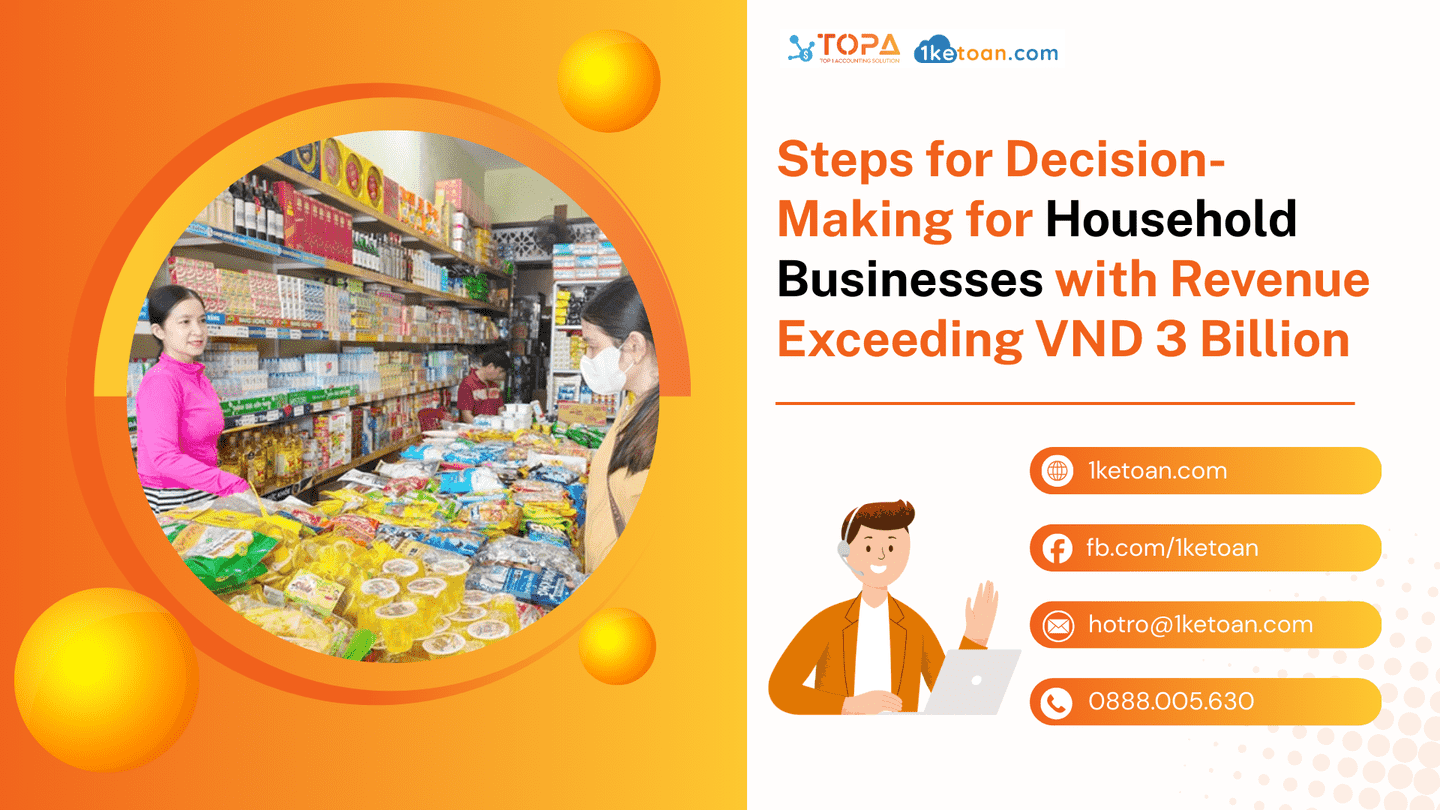
Question 2: Should the household business model be maintained?
For household businesses with projected annual revenue from VND 200 million to VND 3 billion:
It is advisable to continue operating under the household business model, while shifting from the presumptive tax method to the declaration-based method. Invoicing should only be carried out when requested by customers or business partners. This approach helps household businesses comply with regulations while avoiding unnecessary costs and additional tax obligations.
For household businesses with projected annual revenue exceeding VND 3 billion:
In the short term, it is recommended to proactively discuss with tax officers to prioritize maintaining the tax model applicable to the VND 200 million–3 billion revenue group for at least one additional year. This provides time to prepare in terms of financial capacity, human resources, and accounting systems.
However, if the tax authority has clear grounds to determine that a household business has generated revenue exceeding VND 3 billion per year for two consecutive years and does not approve the continued application of the presumptive tax model, such as in the following cases:
- The presumptive tax amount assessed corresponds to annual revenue exceeding VND 3 billion
- The household business is declaring revenue exceeding VND 3 billion per year
- Revenue generated from sales on e-commerce platforms exceeds VND 3 billion per year
In such circumstances, converting to an enterprise model should be seriously considered, as enterprises can optimize tax liabilities, benefit from preferential policies, and operate in a more transparent and sustainable manner over the long term.
Further reading:
Should a Household Business with Revenue Over VND 3 Billion Convert to a Company?
What Should an E-commerce Household Business with Annual Revenue Exceeding VND 3 Billion Do?