



ROADMAP FOR IMPLEMENTING E-INVOICES FOR HOUSEHOLD BUSINESSES IN 2026
Transition roadmap from the lump-sum tax regime to the declaration-based tax method starting 2026: legally compliant, risk-controlled, cost-optimized, and ensuring business continuity.
Nội dung
Why do household businesses need a transition roadmap?
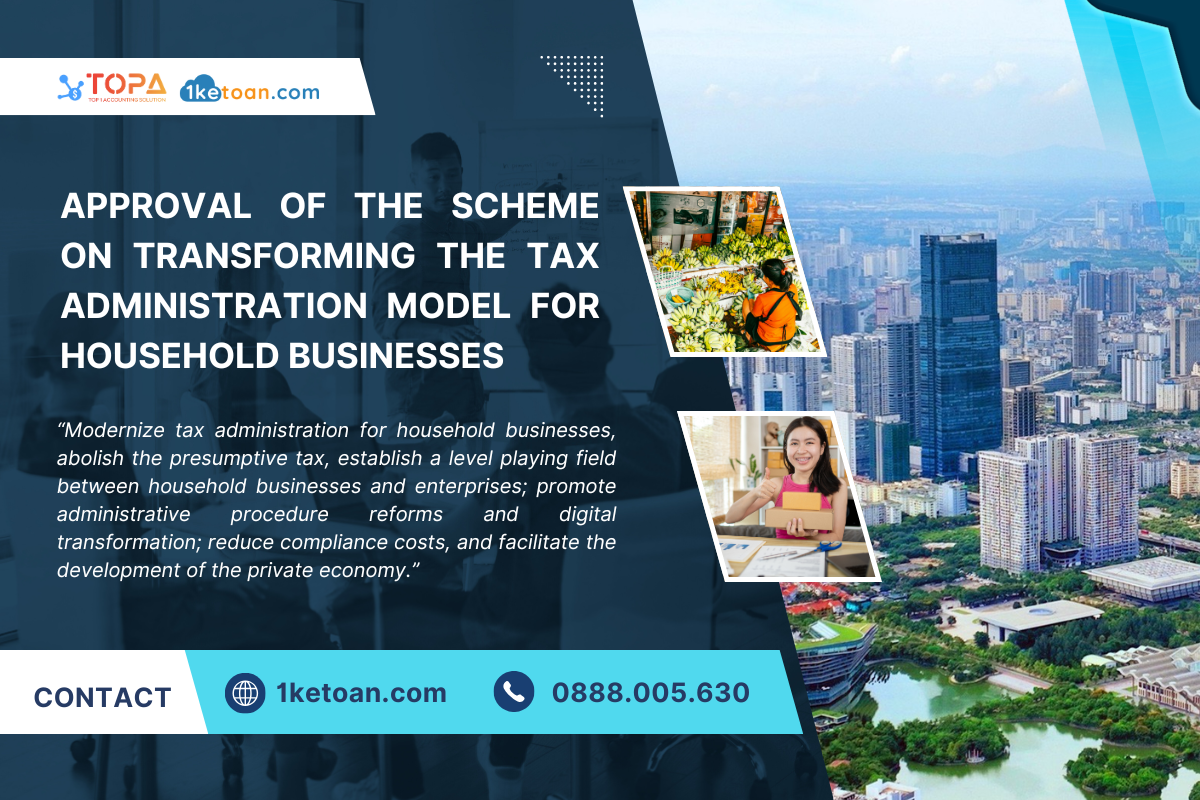
The tax administration changes in the 2025–2026 period are causing concerns for many household businesses: the familiar lump-sum tax model will be replaced by the self-declaration and self-payment mechanism, where all revenue must be transparently recorded and connected through e-invoices under new data standards. This is fundamentally different from the previous system, which was simple and involved minimal paperwork.
However, what household businesses worry about is not the regulation itself, but the questions:
“Will I do it wrong?” — “Will the conversion cost be high?” — “If I make a mistake, will I be penalized?” — “Is there a way to transition smoothly without confusion?”
In reality, the tax authority is tightening data standards and real-time reconciliation, but this also creates opportunities for household businesses to manage revenue more transparently, control costs better, and reduce errors during finalization. The key is not to change everything at once, but to understand — prepare — and then implement, so that the transition happens smoothly.
In this context, a roadmap becomes an essential tool—not an administrative mandate, but a way to reduce risks, avoid passivity, and optimize costs when adopting the new system. A roadmap helps household businesses know where they currently stand, what to prepare first, and when to move to the next step—just enough, without overdoing it.
A clear roadmap not only prevents penalties or mistakes, but also helps household businesses leverage opportunities: more transparent sales processes, easier cash-flow management, and—most importantly—no disruption to their operations.
Legal foundation & core regulatory changes shaping the 2026 roadmap
To understand why a transition roadmap is necessary, it is important to grasp how the legal landscape is evolving. The 2025–2026 period is not a set of isolated changes but the result of multiple legal documents collectively tightening data standards, invoicing mechanisms, and tax administration methods.
Legal Basis
- Decision No. 3352/QĐ-CT dated 31/10/2025 by the Tax Department on issuing the “60-day intensive transition plan from lump-sum taxation to declaration-based taxation for household businesses.”
- Decision No. 3389/QĐ-BTC dated 06/10/2025 by the Ministry of Finance approving the Project on “Transitioning the tax administration model and methods for household businesses upon abolishing the lump-sum tax regime.”
- Law on Tax Administration 2019; Resolution No. 68-NQ/TW (2025); Resolution No. 198/2025/QH15 on tax administration reform and modernization.
Contents
According to Sections 1 and 2, Part II of the Plan issued with Decision No. 3352/QĐ-CT:
Objectives:
- Substantially transition the tax administration model from lump-sum to declaration-based taxation in line with the Law on Tax Administration and relevant resolutions.
- Strengthen communication and support to encourage household businesses to voluntarily transition to declaration-based households or enterprises; promote voluntary compliance, transparency, and fairness in tax declaration and payment.
- Improve technical infrastructure, data systems, and digital management tools, aiming for “one-touch” tax procedures.
- Implement uniformly nationwide, in accordance with the Project under Decision No. 3389/QĐ-BTC dated 06/10/2025.
Scope & timeline:
- Nationwide implementation, focusing on markets, commercial streets, and areas with a high concentration of lump-sum household businesses.
- Implementation period: from 01/11/2025 to 30/12/2025 (60 days).
Thus, the 60-day intensive campaign marks the essential preparation phase for household businesses to officially adopt the declaration-based model from 01/01/2026, ensuring consistency, transparency, and alignment with national tax reform.
Refer to the article Overview of Household Business Tax Obligations in 2025 for a comprehensive understanding of the upcoming changes.
The 8-step transition process from lump-sum household business to declaration-based household business (under current regulations)
Under Clause 6, Article 10 of Resolution 198/2025/QH15, from 01/01/2026, household businesses and individual business owners will no longer apply the lump-sum tax method. All must pay taxes in accordance with tax administration laws, i.e., shift to the declaration-based method.
This means not only changing the tax payment method but also standardizing the entire system of documents, invoices, books, and revenue recognition. Below are the 8 transition steps under current regulations:
Step 1 – Submit the conversion dossier to the tax authority
Household businesses submit Form 08-MST (issued under Circular 86/2024/TT-BTC) to convert from lump-sum to declaration-based taxation.
→ This is the official activation step of the transition process.
Step 2 – Inventory and record all stock on hand
Prepare an inventory record of all stock (with and without invoices) to establish the opening balances for the accounting system.
→ This serves as the foundational data for the new accounting system.
Step 3 – Register and use e-invoices according to the correct model
Once converted to declaration-based taxation, household businesses must use e-invoices:
- Direct retail → register for e-invoices generated from POS systems.
- Services, wholesale → register for standard e-invoices (sales invoices).
→ Choosing the correct invoice type reduces risks and optimizes costs.
Step 4 – Adopt accounting software or maintain books manually using Excel
Household businesses may:
- Use accounting software designed for declaration-based households, or
- Maintain books on Excel if they have strong accounting knowledge.
→ This is where many worry about costs—should be considered based on scale and needs.
Step 5 – Set up accounting books according to regulations
Household businesses must maintain 7 types of accounting books as required in Appendix 2 of Circular 88/2021/TT-BTC.
→ This is a mandatory legal requirement.
Step 6 – File periodic tax returns (monthly or quarterly)
Submit tax returns using:
- Form 01/CNKD (under Circular 40/2021/TT-BTC).
- Attached Appendix 01-2/BK-HĐKD if applicable and revenue can be substantiated.
(If revenue is certified by relevant authorities, the appendix is not required.)
→ This is the biggest shift from lump-sum to declaration-based taxation.
Step 7 – Open a dedicated bank account for the household business
Separate it from personal accounts to handle business transactions.
→ Reduces cash-flow risks and facilitates reconciliation—especially as tax authorities tighten data monitoring.
Step 8 – Register social insurance (if employees are hired) and for the owner
Declaration-based household businesses must pay social insurance for employees (if any) and for the household owner as required.
Important Note
Once officially applying the declaration-based tax method, household businesses must retain valid invoices and supporting documents for all purchases and sales.
→ This is the core principle of the declaration method: missing invoices = risk.
Detailed process for household businesses
See the full step-by-step guide and video tutorial here:
https://1ketoan.com/2025/11/25/ho-kinh-doanh-can-chuan-bi-gi-khi-xoa-bo-thue-khoan/
E-invoices are not difficult when household businesses start with the right roadmap
The shift from lump-sum tax to declaration-based taxation makes many household businesses anxious: Will costs increase? Will procedures get more complicated? Will mistakes lead to penalties? In reality, e-invoices or accounting books are not the most difficult parts. The hardest part is knowing where to begin, following the correct sequence, and avoiding small errors that can lead to major risks.
A clear roadmap helps household businesses move step-by-step with confidence—knowing what to prepare, forecasting costs, minimizing errors, and keeping operations running smoothly. Importantly, you do not have to do everything alone.If needed, support units like TOPA or 1ketoan can accompany you throughout the process—from initial review, invoice system setup, to bookkeeping and periodic tax declaration. The goal is not to force change, but to help you transition safely, efficiently, and in full legal compliance.